It's storytelling, silly!
I published the previous essay during June last year. Since then, my domain got expired, I purchased a new domain, switched hosting service and here we go again! Another annual revival ritual of my blog.
I spent most of the last year inside home. I was working inside the same four walls where I eat, sleep and hang out. There is little room to switch context, relax and have a life outside work. Productivity became a buzzword. I wanted to find alternate ways to stop checking mails, log off and think about something that's not work. Enter the world of sports.
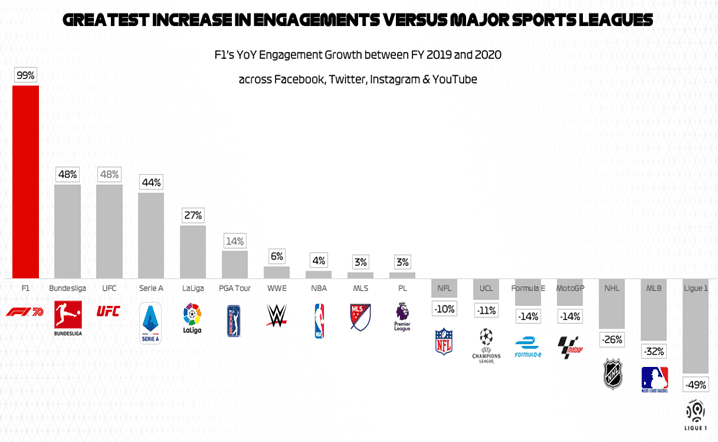
I have always been a fan of sports. Started with cricket, I have followed Tennis, three Olympic Games, Football, and darts tournaments. I started watching Drive to Survive, an entertaining, borderline hyperbole, documentary on Formula 1 (F1). I got hooked into the sport and have followed all six weekends of this years Grand Prix. F1 has all the drama of a soap opera, brilliant engineering innovations, man and machine pushing to their absolute limits. F1 is speed. It's not just me. F1 has gained a lot of fan engagement in social media during 2020 compared to other major sport leagues.
What happened? How did this motorsport get so much traction during the last few years. What have they done right that can be applicable to other sports and beyond?
A fan follows sports for the same reason they go to movies. They want to see a hero who can do interesting, challenging things that most people cannot. While the heroes are fictional in movies, athletes are real life protagonists. Every sport revolves around the stories of their athletes. Movies make money by selling copies. Sports make money by selling match day tickets or sponsorships. Both need a captivating story that will hook audience. Greater the hook, more people will tune in, more money for the establishment. What are the key elements of a story that hooks people in?
Every story needs a setting. A context in which people can hop in. For sports, it can be a ball, net and sometimes nothing but running against others. An activity, to be a sport, requires higher bar to entry. For example, there are only handful of people in the world who can run 100 meters in less than 10 seconds. That narrows down names like Usain Bolt, Justin Gatlin, Yohan Blake. Fewer names, fewer story-lines to follow. If many people can do something on par with world class athletes, it is not a viable sport.
Characters are pillars of a story. Characters who win, who stop protagonists from winning, who support others. In a team sport, you got them all. Anyone supporting an athlete will perceive the opponent as a villain. Team members and coach are supporting characters. Team based sports have more characters than individual ones. Hence they're more popular (refer the graph above).
Once we have the set the characters in place, a plot is needed to build the story. In sports, every season is a plot with an objective—win the trophy. If a trophy is rare, the plot line become valuable. Hence world cup, once in a four years event, is more coveted than other trophies in football and cricket. World cups and championships are strong story lines.
Conflicts enhance stories. Sport rivalries are confrontational by design. They also add uncertainty to the plot and leave the audience guessing about the result. While one champion's story is enjoyable, two world class athletes give audience options. Federer vs Nadal, Messi vs Ronaldo, Barcelona vs Real Madrid are all classic sports rivalries that can pull bigger crowd.
There are other elements such as style and tone that can improve the packaging. But, one should ace the core components—setting, characters, plot and conflict to tell a convincing story. That is all there is to build a global sports franchise that pulls in massive crowd. What did F1 do?
Formula 1 has nailed their storytelling technique with recent initiatives. Fast cars in exotic locations is the setting. Twenty world-class drivers across ten teams. You have rivalry between drivers, teams, and drivers in the team. Usually, the newspapers focus on who won the race or the championship that year. Netflix documentary focused on the teams and drivers that did not win championship but had their own battle with rivals. By the end of the documentary, a fan is briefed about all twenty drivers, ten teams and their individual story lines. Best marketing campaign ever.
Mercedes won the last seven championship for constructors. Their drivers also won seven championships, including Lewis Hamilton's six and Nico Rosberg's 2016 title. Isn't it boring to watch a sport where the same guys win? This is where packaging helps for Formula 1. In 2016, rivalry between Rosberg and Hamilton was in the spotlight. In 2018, both Hamilton and Sebastian Vettel were aiming for their fifth championship title. This year, Max Verstappen and Hamilton are going wheel to wheel. Hamilton may win his eighth championship but the rivalry with Verstappen will keep people hooked. It's all about the story line regardless of the end result.
F1 also has positioned itself away from controversial political topics. It uses #WeRaceAsOne campaign to offer solidarity to covid-19 and racial inequalities. But many Grand Prix weekends happen in countries with questionable human rights record. Formula 1 circus is a perfect recipe of story lines to sell to global audience. The sponsorship names on every car's livery shows the amount of money in the sport. After a race, drivers jump out of their car and immediately wear their sponsors watch before posing to the photos. It's a well orchestrated theatre.
It's possible to spend money and create buzz around an event. Athletes may arrive and leave. The sport will go through its era of dominance and competition. But, storytelling is the key to make a fan stay. People don't always remember every single game but they will never forget how it made them feel. That is why most people, including me, follow sports.